
Fishing gear is literally built to catch the seafood that ends up on our plates, but what’s the plot twist for other ocean animals when that gear goes missing?
Lost and abandoned fishing gear, aka “ghost gear”, is basically the final boss of marine debris when it comes to wildlife damage. Think of it like a horror movie villain: crafted from modern plastics like nylon or polyethylene, this stuff was designed to trap and hold…and it doesn’t exactly clock out when the cameras stop rolling.
No fisherman is out here trying to lose their gear. It’s a whole investment, and it’s literally how they provide for their families and the rest of the world. But when the gear goes MIA—whether it gets snagged on a rocky sea floor or a surprise storm sends it off-script—it doesn’t just disappear. It keeps running its scene, trapping and entangling wildlife long after anyone called cut. It’s the horror franchise that keeps going. (Like, what Scream are we on now? 14?)
Thankfully, Ocean Conservancy’s Global Ghost Gear Initiative (GGGI) works alongside fishermen and global experts to find solutions to this global problem. Dive in to see how ghost gear might affect your favorite marine A-listers:
FISH: THE OPENING SCENE
The most obvious target? Fish. And the body count is staggering. Estimates vary by species and fishery, but one assessment of Norwegian Greenland Halibut found that stocks decline by as much as 30% annually due to the impact of ghost gear. That’s 30% fewer fish for fishermen to harvest, hitting wallets hard and quietly shrinking food access for people around the world. Classic horror setup: the threat you can’t see, racking up damage in the dark.
LOBSTER: THE TRAP IS ALREADY SET
Every great horror movie has that scene—the one where the trap has already been sprung before anyone realizes it. Enter the lost lobster trap. In the U.S. and Canada, most lobster traps are made from Polyvinyl Chloride (PVC)-coated metal, engineered for serious durability in brutal marine conditions. Translation? These things do not quit. Once lost, a trap keeps doing its job indefinitely: a trapped lobster dies, becomes bait, lures in the next victim and the cycle repeats. Some fisheries–like the American Lobster fishery–have written an escape clause. Mandatory “escape doors” are designed to activate after a set time, giving trapped animals a way out. But it’s not foolproof… if the door is too small or fails to trigger, the cycle continues. GGGI has worked with lobster fisheries across Mexico, Canada, the Caribbean and the U.S. to trial new technologies aimed at finally shutting down ghost gear’s endless encore.
CRABS: TRAPPED IN GRuesome numbers
Like lobsters, crabs are caught in large traps sitting on the ocean floor—and as you may have caught on, a lost trap doesn’t retire, it just goes rogue. In the Chesapeake Bay alone, an estimated 145,000 derelict crab pots are out there running unsupervised, quietly killing approximately 6 million crabs, 3.5 million white perch, and 3.6 million Atlantic croaker every single year. It’s a horror sequel that keeps renewing itself. But here’s where the plot thickens: researchers at the Virginia Institute of Marine Science have shown that actively removing these derelict pots has increased harvests across the Bay and put an extra $33.5 million in the pockets of Bay crabbers. In this story, fighting back actually works.
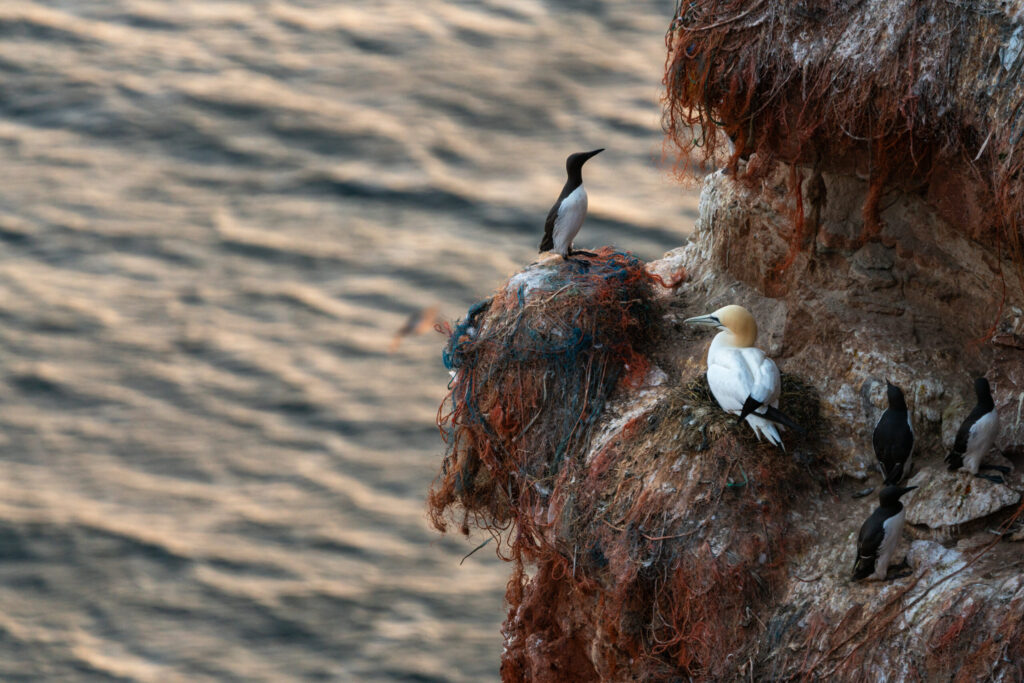
BIRDS: THEY NEVER SAW IT COMING
In most horror movies, there’s always a victim that catches the audience off guard–and ghost gear’s reach into the skies above our ocean is exactly that plot twist. Seabirds are critical links between air and sea, but in a survey of 5,000 derelict fishing nets pulled from Puget Sound, researchers counted 25,000 birds among the trapped. Seabirds are drawn to fishing vessels, lured in by the same bait meant for fish—and ghost gear doesn’t discriminate. The silver lining? Fishermen are largely on the same side here. Keeping birds away from active gear is in their own economic interest, and tools like streamer lines and line weighing have emerged as solid defenses—proof that not every chapter in this story ends in tragedy.
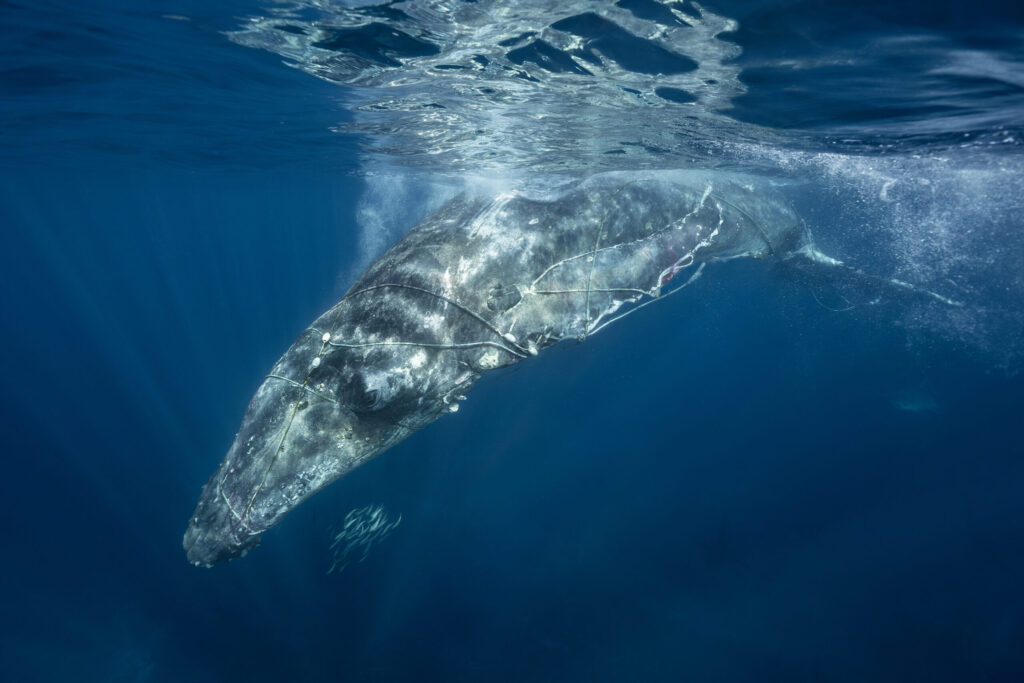
WHALES: THE GIANT FALLS
If ghost gear were a horror franchise, whales would be the most devastating act. The International Whaling Commission estimates that more than 300,000 whales and dolphins die annually from bycatch and entanglement—both lost in gear and actively deployed lines. In the U.S. alone, 95 large whales were confirmed entangled in 2024, including humpback, fin, gray, bowhead, and critically endangered North Atlantic right whales. And the horror cuts both ways—when a whale is ensnared and drags expensive fishing gear into the deep, fishermen pay the price too. Nobody wins when the biggest creature in the scene gets caught in the trap.
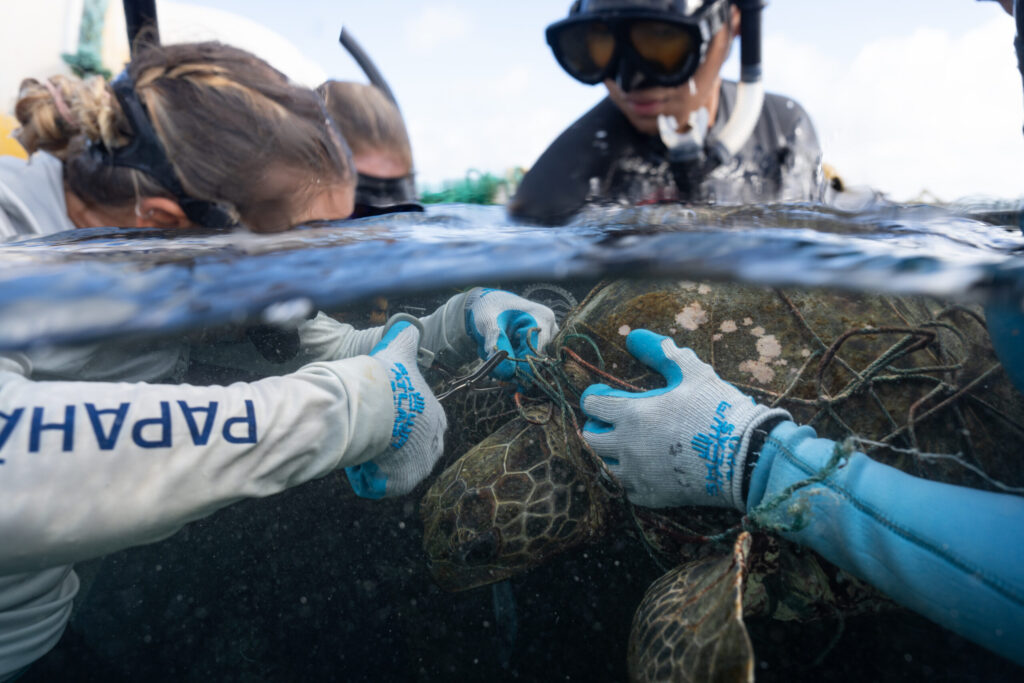
SEA TURTLES: ANCIENT SURVIVORS MEETING A MODERN MONSTER
Sea turtles have survived on this planet for over 100 million years—they outlasted the dinosaurs. But ghost gear is proving to be a villain unlike anything they’ve faced before. Five of seven sea turtle species are considered threatened or endangered according to the International Union for Conservation of Nature (IUCN) Red List of Threatened Species, and they rank among the species most vulnerable to ghost gear entanglement. A 2014 study identified more than 1,000 cases of stranded sea turtles linked to fishing gear in Florida alone—just between 1997 and 2009. The good news is the heroes are showing up: turtle excluder devices are now required in many trawl fisheries, and biodegradable materials are being trialed in fish aggregating devices. Ancient species. Modern threats. And a growing arsenal of tools fighting back.
SEALS: CURIOSITY CAUGHT THE pinniped
In horror movies, it’s always the curious one who wanders toward the danger, and for seals and sea lions, that instinct is proving deadly. Their nationally inquisitive nature draws them toward lost gear for a closer look, and far too often, that becomes entanglement. A 2024 study on Hawaiian monk seals found that plastic fishing gear components made up a staggering 76% of entangling items on the animals. And that threat doesn’t stay at sea—accumulations of abandoned gear on land can disrupt breeding behavior when it creeps into critical habitat. Ghost gear doesn’t clock out when it washes ashore. It just finds a new scene to haunt.
sharks: the apex predator becomes the prey
Cue the Jaws theme… except in this flick, they’re the victim. Sharks sit at the top of the ocean food chain—their health is our ocean’s health. So in 2013, scientists were stunned to uncover a major, previously unknown source of shark mortality: entanglement in drifting fish aggregating devices, or FADs. These structures dangle netting in the water column to attract fish, but they’re indiscriminate in what they snag. The findings were grim. Ghost gear was essentially doubling the annual toll on silky sharks, operating as an invisible, unregulated predator lurking just beneath the surface. For the conservation of this species, the implications are nothing short of a nightmare scenario.
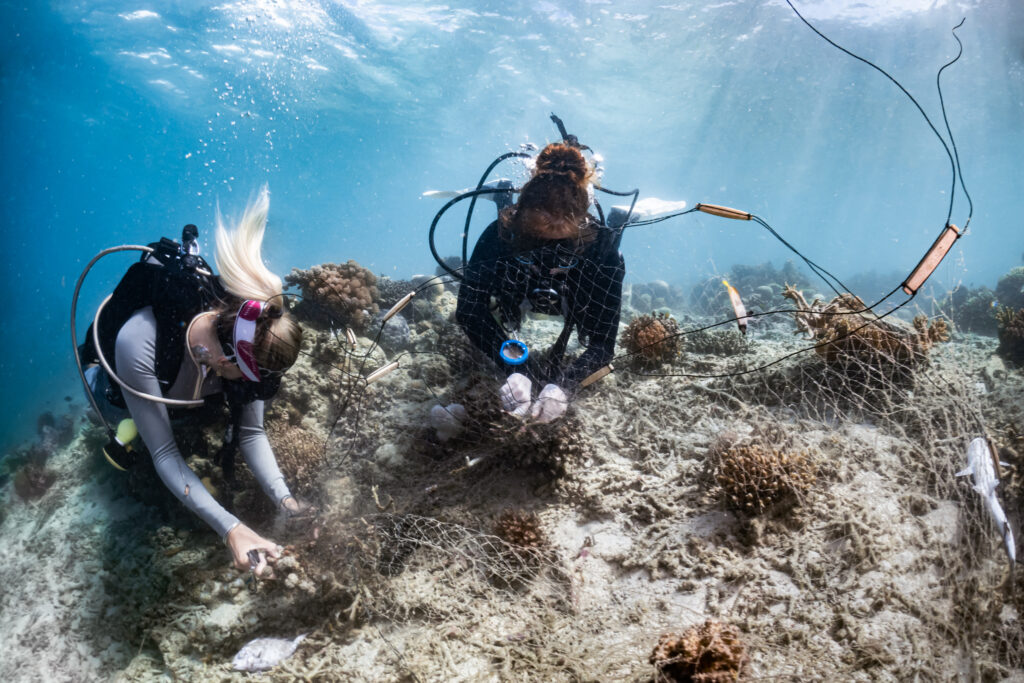
corals: don’t let the looks fool you
Plot twist—corals aren’t plants or rocks. They’re animals. And ghost gear is quietly dismantling entire cities they’ve spent centuries building. Nets and lines drag across fragile reef structures, breaking off coral heads and triggering a cascade of destruction that ripples through entire ecosystems. Fewer coral means less biodiversity, disrupted food chains, and corals left defenseless against storm surges. Studies confirm the grim pattern in ghost gear hotspots: more broken coral, shrinking coral cover, and lower species diversity. Coral reefs are our ocean’s most biodiverse neighborhoods—and ghost gear is tearing them apart, one broken branch at a time, in the dark, with no one watching.
VAQUITA PORPOISES: ALMOST THE FINAL GIRL
With only 10 individuals left in the wild, the vaquita porpoise is the most endangered marine animal on the planet. Their devastating decline traces back to illegal gillnets set for totoaba, a black-market fish, in Mexico’s northern Gulf of California. Think of the vaquita as the final girl of this horror story: battered, barely surviving, while the threat continues to circle. Large-scale international conservation efforts, like the removal of thousands of gillnets and the creation of a marine reserve, have fought to keep the species alive. But with the area reopening to fishing, the nightmare isn’t over. The vaquita’s ending remains unwritten, and the stakes could not be higher.
THE CREDITS AREN’T ROLLING YET
Ghost gear is a persistent villain—relentless, invisible and operating on a global scale. But the thing about the best horror movies? The monster doesn’t always win. Organizations like the GGGI working on this issue aren’t just creaming into the void. They’ve found something arguably more powerful than the threat itself—a global community that actually shows up. From fishermen to scientists to policymakers and ocean lovers, the cast of people fighting back is growing—including Protect Where We Play’s own U.S. SailGP Team (check out our ‘trailer’ here)! The sequel to this story hasn’t been written yet—and there’s genuine reason to believe it doesn’t have to end in tragedy. Learn more about the GGGI’s work here and join the movement to protect our ocean!
