
MEET NEW TEAM OCEAN COACH, OVIE MUGHELLI
We’re thrilled to welcome NFL veteran Ovie Mughelli as our newest Team Ocean Coach! He is an award winning, 2x All-Pro NFL veteran who has continued to leverage his platform as an environmental & sustainability leader, wellness advocate, author, media correspondent and owner of a medical consulting business.

Q: Your parents instilled in you the idea of, if you can make someone’s life better, you do it. How has that ethos guided you from an environmental advocacy standpoint?
A: My parents came to this country as Nigerian immigrants, and I grew up watching what sacrifice, perseverance, and faith really looked like. They had to build a life in a new country, find their way, create opportunities for our family, and keep moving forward even when things were not easy. But what always stood out to me was that no matter what they were dealing with, they never stopped caring about other people. They expected us to work hard, take advantage of every opportunity we were given, and then use those opportunities to make a difference. There was always this understanding in our home that success was not just about what you accomplished for yourself. It was about what you did for somebody else once you had the ability to help.
So for me, a lot of what I do today is my way of honoring that foundation and saying thank you. My parents sacrificed so much to give us a chance to build meaningful lives in America. I want to make sure I do something meaningful with that chance. That is how I look at environmental advocacy too. If I have a platform, relationships, resources, and the ability to bring attention to something that affects our children and future generations, I believe I have a responsibility to use them. My parents taught me that when you have the opportunity to make things better, you do not waste it.
Q: What do you feel when you look at the ocean?
A: I think about home.
I was born in Boston, then lived in New York and Texas before my family finally settled in Charleston, South Carolina. Charleston is one of those places people fall in love with, and a big part of that is the water. The ocean is part of the identity of the city. It shapes the culture, the beauty, the pace of life, and so many of the memories people create there. So for me, the ocean has always felt personal.
When I look at it, I feel peace. There is something about standing near the water that slows you down and puts things in perspective. It reminds you how big the world is, how small we are, and how connected everything really is.
But I also feel responsibility. When something has given you that much beauty, that much peace, and that many memories, you do not just take from it. You have a responsibility to protect it.Charleston helped teach me that. The ocean is not just something beautiful to look at. It is part of our communities, our way of life, and something worth preserving for the people who come after us.
Q: During your time at the NFL, you made climate a topic in the Atlanta Falcons locker room. What’s a lesson you learned from your teammates that came around to your message, and the ones that didn’t?
A: One thing football teaches you very quickly is that everybody does not respond to the same message.
Some guys wanted facts. Some guys connected with what it meant for their children. Some guys cared more when you talked about health, their communities, or the places where they grew up. And some guys simply did not feel like it was that big of a deal. They were not looking outside and seeing the sky falling or the ocean on fire, so to them, it did not feel urgent. And I understood that. There are a lot of things competing for our attention every single day, and people have to decide what they are going to focus on.
What I learned is that you cannot always lead by lecturing people. Sometimes you have to meet people where they are.
I also saw how quickly environmental issues could become political, and that never made much sense to me. The ocean does not care how you vote. The climate does not check your political affiliation before it affects your community. At the end of the day, these issues are about people, families, health, and the places we all call home. The guys who came around usually did because the issue became personal to them. They saw how it connected to something they already cared about. And with the guys who did not, I learned not to force it. You keep living your values, you keep showing up, and sometimes your actions make a stronger argument than your words ever could.
For me, it really comes down to this. If there are things we can do today to better protect our families, our communities, and the world our kids will inherit, I would rather be part of doing something than explaining later why we did not.
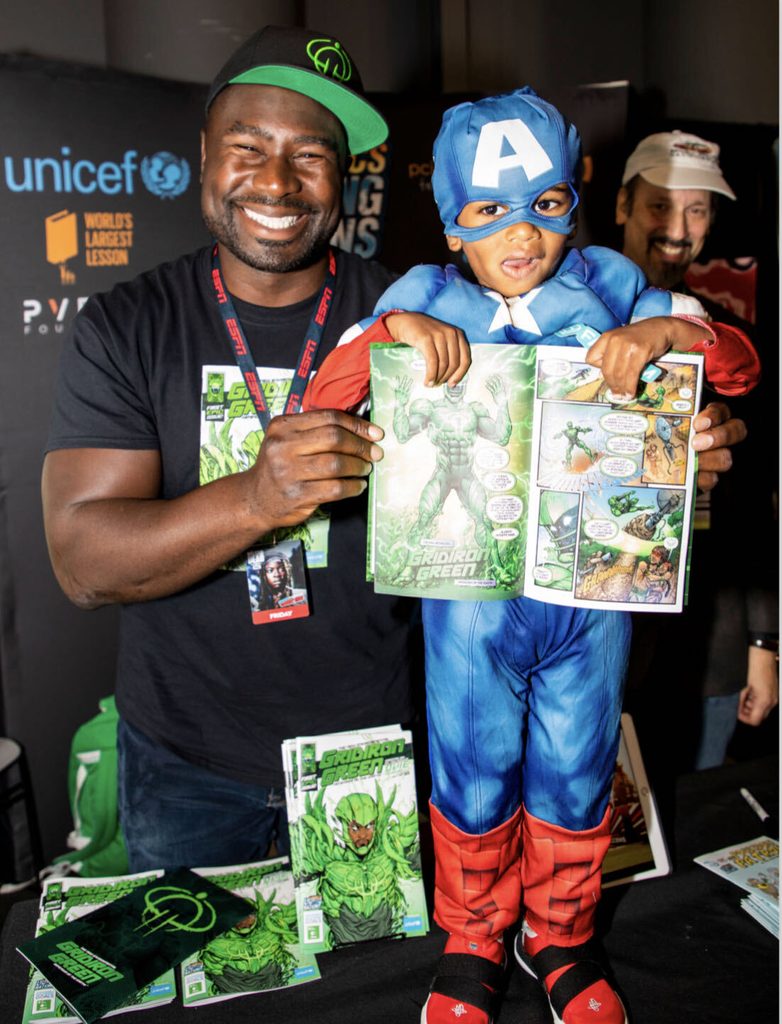
Q: You’ve mentioned that Captain Planet was your first introduction to environmentally conscious programming. Can you give us your own “Planeteer Alert” and share a practical, real-world tip on how to protect the environment and reduce daily waste?
A: First, I have to give a lot of love and credit to Ted Turner and Laura Turner Seydel.
It is funny, because as a kid I was reading Captain Planet comics and watching the cartoon, and I never imagined that one day I would actually meet the people behind it and have them become such an important part of my own environmental journey. What I appreciated most is that they never told me what to think, what to believe, or what to say. They gave me access. They educated me. They were patient with me. They introduced me to people, ideas, and experiences that helped me ask better questions and come to my own conclusions. In a lot of ways, they wrapped their arms around me and helped guide me down a path that eventually led me here. I also have to thank them for understanding the importance of representation. Kwame was a huge reason I connected with Captain Planet in the first place. He was not just a Black character. He was an African character, and he had the power of Earth. At a time when there were not a lot of strong Black characters in cartoons, seeing Kwame mattered to me. I saw somebody who looked more like me, and that opened the door to the larger environmental message.
So my Planeteer Alert would be this: pay attention to what your life supports.
Our habits send a message. What we buy. What we throw away. How much energy we use. How much food we waste. What companies we support. What we teach our kids. Individually, those things can seem small, but multiplied across millions of people, they become culture. So instead of trying to be perfect, do an audit of your own life. Pick one area where you know you are being wasteful and change it. Waste less food. Buy less of what you do not need. Reuse more. Conserve water. Be more thoughtful about energy. Support businesses that are trying to do things the right way.
The biggest thing is to stop thinking somebody else has to go first. Captain Planet taught us that “the power is yours,” and I think that still applies. The question is whether we are actually going to use it.
“I’ve said my whole life that I would do anything for the people I love, especially my family. A lot of us say that. But if we really mean it, then we also have to care about the world we’re leaving them. For me, that means paying attention to what’s happening to our oceans and our environment and deciding to do something about it.
Football taught me there’s a difference between talking about what matters and showing it through your actions. I’ve always tried to let my actions speak for me. That’s what joining Ocean Conservancy means to me. It’s a chance to step up, do my part, and help create real change for the people we love and the generations coming behind us.”
—Ovie Mughelli, 2x All-Pro NFL Veteran and Team Ocean Coach
Q: Protect Where We Play is built on the idea that sports, entertainment and fandom can move people in ways policy and science alone can’t. What’s the ask you’d make of anyone with a platform who hasn’t stepped up yet?
A: I would ask them a simple question: what are you doing with the influence you have been given?
Having a platform is a privilege. Whether you are an athlete, entertainer, business leader, creator, or somebody with a large following, people are listening to you. You do not have to know everything. You do not have to become a scientist or an environmental expert. But you can learn, you can amplify people who do know the issues, and you can use your voice to move people toward something positive. I spent my career believing that leadership means showing up when something matters. If you have the ability to influence people and you know something matters, I think there comes a point where staying silent becomes a choice too.
Q: Do you have any other personal notes about why you’re excited to be part of this movement to Protect Where We Play?
A: I am excited because this feels like a chance to bring together two things I care deeply about: sports and leaving something meaningful behind. Sports have given me so much. They gave me friendships, opportunities, a career, and a platform I never could have imagined when I was a kid. Now I get to use some of that platform to help protect the places where future generations will play, compete, grow up, and make their own memories. And at this stage of my life, that matters to me even more. I have three kids. I think a lot more about what we are handing to the next generation.
I do not want to just tell my children that I cared about these things. I want them to be able to look back and say that I actually did something about them.
The power is yours! By joining Ovie and taking action to #ProtectWhereWePlay, you’re protecting the ocean and the future of the sports and entertainment we all love.
